By Paul Yang, CFP®, JP

You are planning to sell an investment after the new capital gains tax rules begin on 1 July 2027. After the relevant adjustments, you have a $100,000 taxable gain that falls within the new minimum-tax rules.
You have heard “30% minimum tax”, so you plan to keep $30,000 of the proceeds available for tax.
In the two examples below, that would leave you short. The sale adds $32,000 to the tax bill when there is no other taxable income, and $37,350 when there is $100,000 of other taxable income. Both amounts include Medicare levy.
The gain is the same. What changes is the income alongside it. Here is how to work out the amount you would need to set aside.
Start with the gain that will be taxed
Our $100,000 is the gain after the applicable tax adjustments, such as allowable costs, inflation adjustments and capital losses. In this example, all of it enters taxable income and is subject to the minimum-tax check.
The investment might sell for a much larger amount. The $100,000 is the relevant taxable gain, rather than the full sale proceeds. We do not halve it again under the old 50% discount.
If an investment also has earlier growth that keeps its discount under the transition rules, that part needs a separate calculation. We leave it out of this example so we can focus on how the minimum works.
What does the 30% minimum actually do?
Capital gains tax forms part of your personal income-tax calculation. The taxable gain joins your other taxable income, and ordinary income tax is calculated using the income bands.
The new rule then checks how much ordinary income tax this gain adds. Calculate ordinary tax with the gain included, and subtract the ordinary tax you would pay without it. Compare that difference with:
$100,000 × 30% = $30,000.
If the gain adds less than $30,000 of ordinary income tax, an extra amount—called a top-up—fills the gap. If it already adds $30,000 or more, there is no top-up. The ordinary income tax still applies.
This comparison is made before tax offsets. Medicare levy is worked out separately, so there is another step before we reach the final amount.
Case 1: the gain is your only taxable income
Without the sale, you have no taxable income and no income tax. With the sale, your taxable income is $100,000.
Using the 2027–28 resident rates, ordinary income tax comes to $20,252. It is below 30% because income is taxed in bands: the first $18,200 is tax-free, the next $26,800 is taxed at 14%, and the remaining $55,000 at 30%.
The gain has therefore added $20,252 of ordinary income tax. To reach the $30,000 minimum, the top-up is:
$30,000 − $20,252 = $9,748.
Ordinary tax and the top-up now total $30,000. Add the full 2% Medicare levy on $100,000—another $2,000—and the sale adds $32,000 to the bill.
That explains the first shortfall: allowing $30,000 would cover income tax in this case, but leave the Medicare levy unfunded.
Case 2: you also have $100,000 of other income
Now keep the gain unchanged and add $100,000 of other taxable income for the same financial year.
Ordinary income tax on that other income alone is $20,252. Including the gain brings taxable income to $200,000 and ordinary tax to $55,602.
The gain has added:
$55,602 − $20,252 = $35,350 of ordinary income tax.
Why is this more than in the first case? The other income has already used the lower tax bands. The gain sits on top of it and spans the 30%, 37% and 45% bands.
The resulting $35,350 already exceeds the $30,000 minimum, so the top-up is zero. Add the $2,000 increase in Medicare levy, and the sale adds $37,350 in total.
Put the two results side by side
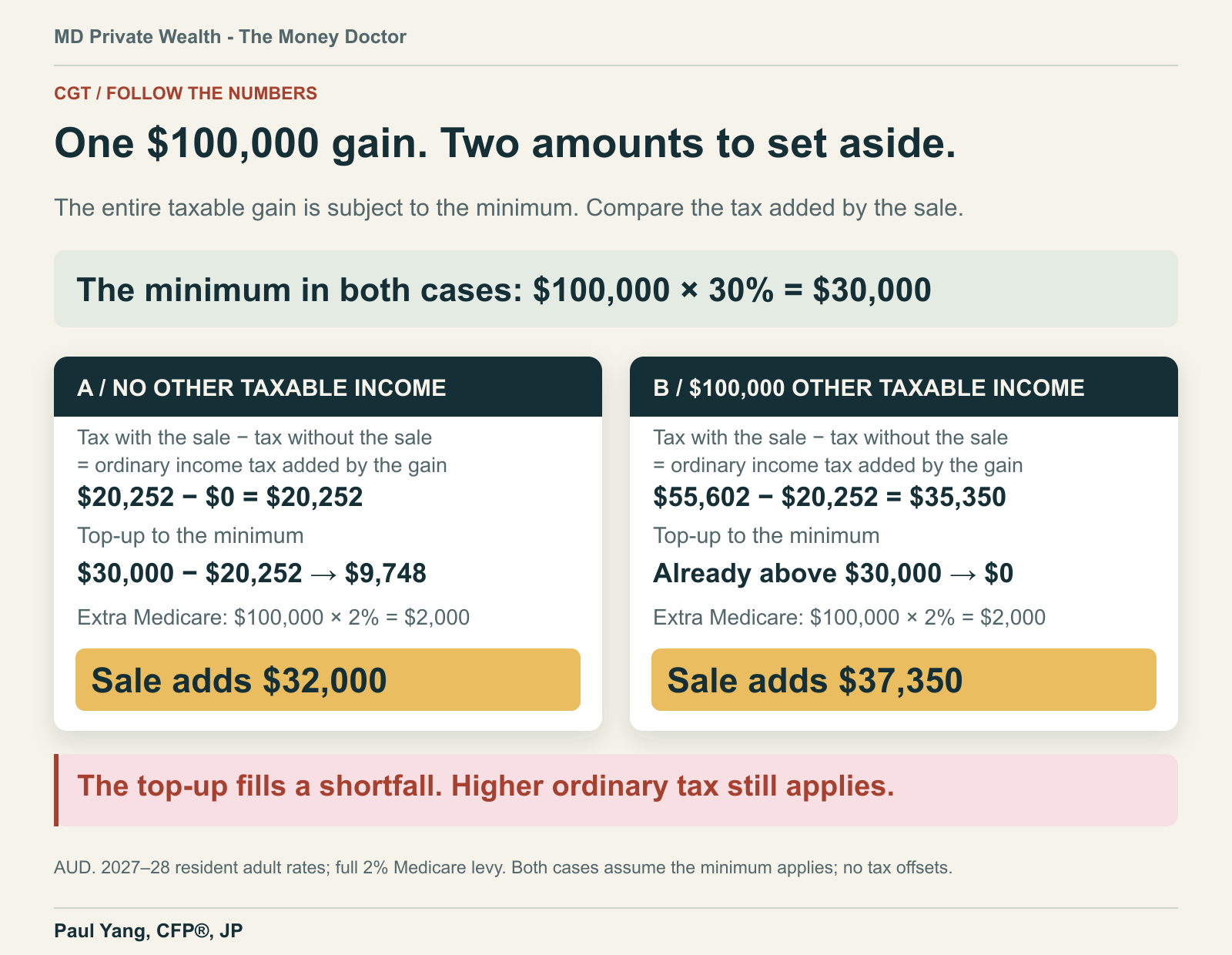
The lower-income case has $5,350 less tax. Lower income can still help; the minimum limits how far the income tax on this gain can fall.
These are two income situations using the same gain and tax rates. The comparison shows the effect of other income, rather than predicting the benefit of delaying a real sale.
How much of the year's tax belongs to the sale?
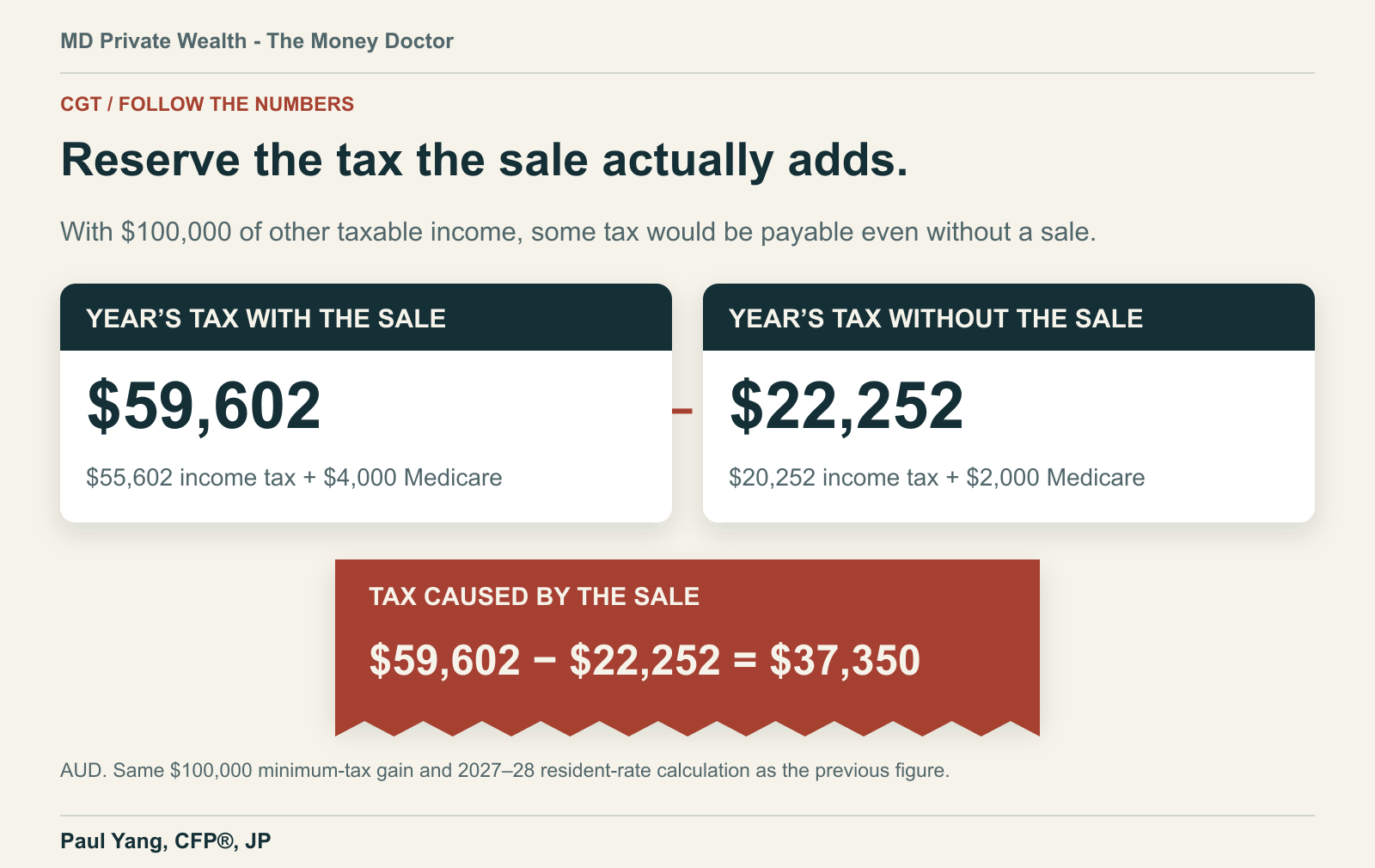
In the second case, the full year's income tax and Medicare levy total $59,602. However, $22,252 would have been payable on the other income even without selling.
Subtract that existing bill, and the amount attributable to the sale is $37,350. That is the additional amount to allow for from the sale proceeds. The tax on your other income still needs to be covered separately.
Before you choose a sale year
Start by confirming the taxable gain and which part is subject to the minimum. Then estimate your other taxable income for the whole financial year, including salary and net investment income. Stopping work partway through the year does not erase income already earned.
Ask your adviser or accountant for tax calculations with and without the sale. The difference shows the sale's additional tax cost. Allow for selling costs and any loan repayment as well, so you can see how much cash will remain for retirement spending or your next investment.
Your payment position also matters. Receiving a qualifying payment such as Age Pension during the year can remove the minimum-tax top-up, while ordinary income tax may still apply. Retirement alone does not establish that exception.
The useful result is a dollar amount you can plan around: what the investment will leave you after tax, costs and debt repayment.
About these examples: AUD; a full-year Australian resident adult using 2027–28 rates. The $100,000 gain is already calculated and wholly subject to the minimum; no other capital gains, deductions, tax offsets or minimum-tax exception. Full 2% Medicare levy, with no reduction, exemption or surcharge.
General information.