By Paul Yang, CFP®, JP

Imagine selling an investment in 2027–28, after the new CGT rules begin, and using some of the proceeds to build your retirement savings. Putting $20,000 into super and claiming a tax deduction seems an obvious place to start.
Your taxable income falls. Your ordinary income tax falls. Yet your personal tax and the tax charged inside super could add up to $2,600 more overall.
The reason is the interaction between Australia's new CGT minimum and the tax charged on deductible contributions inside super. To understand it, follow the same person through two versions of their tax return.
First, understand what the deduction changes
For relevant gains from 1 July 2027, the new rules compare the ordinary income tax attributable to a defined capital gain with a 30% minimum. A top-up fills any shortfall, before tax offsets. Medicare is calculated separately.
The rules use two separate calculations. An eligible personal super deduction reduces taxable income when working out ordinary income tax. But it is not one of the deductions allowed against the gain used for the CGT minimum.
That distinction is the key to the example: the deduction can make ordinary income tax smaller while leaving the minimum amount unchanged.
Without a contribution: $32,000 in total
Take a full-year Australian resident adult in 2027–28 with a $100,000 gain subject to the minimum-tax rules and no other income. The gain has already been calculated under the relevant CGT rules; it is not the investment's sale price. The entire $100,000 enters taxable income and is subject to the minimum; it is not halved again under the old discount.
We assume the $20,000 contribution is fully deductible, within the person’s available contribution limit, and taxed at 15% inside super. The full 2% Medicare levy applies. Detailed assumptions are set out at the end.
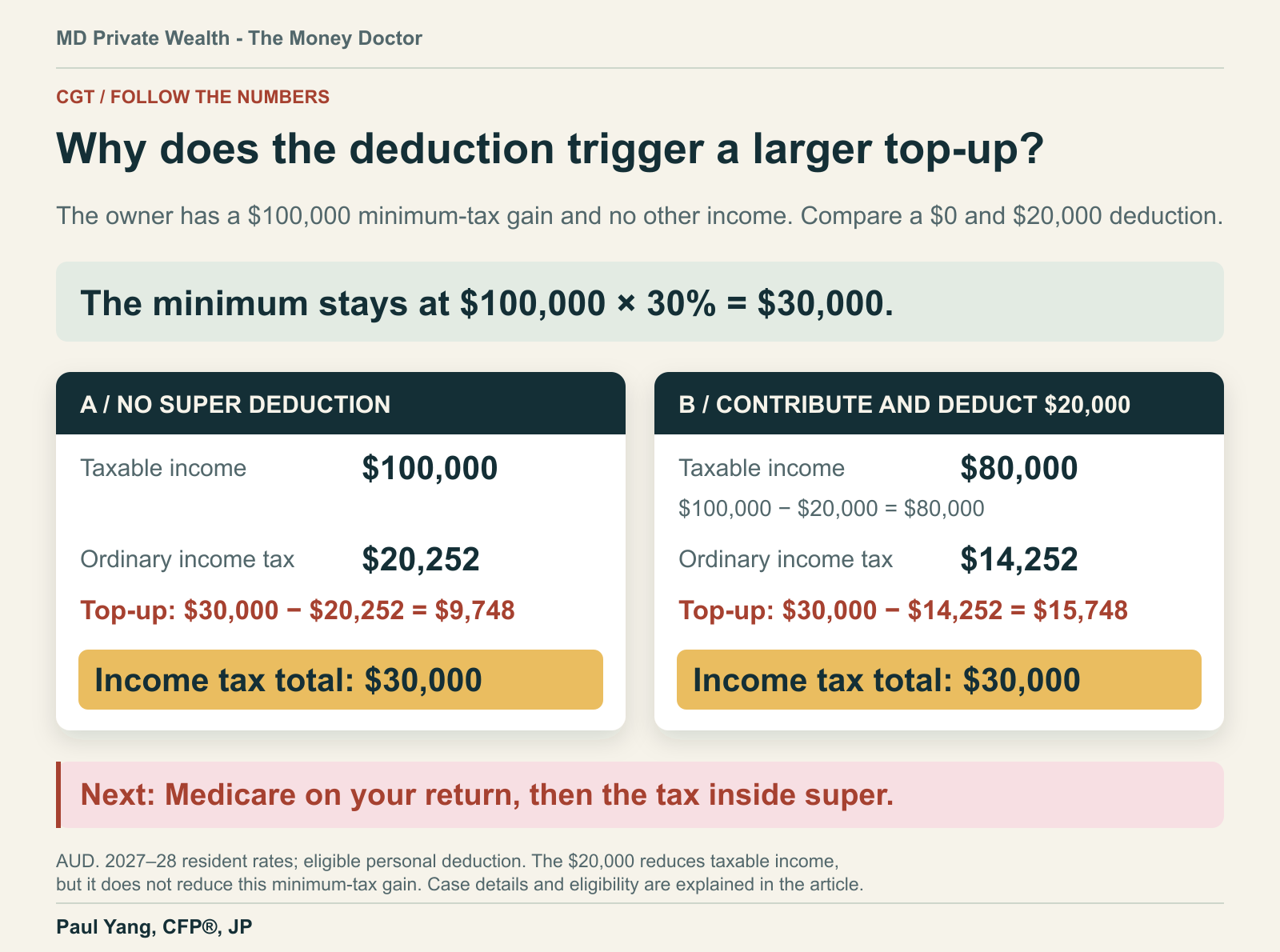
Without the contribution, taxable income is $100,000. Ordinary income tax under the 2027–28 resident rates is $20,252.
But 30% of the $100,000 gain is $30,000. Ordinary tax is $9,748 short, so a $9,748 top-up brings income tax to $30,000.
Add the $2,000 Medicare levy, and the total is $32,000.
With a $20,000 deduction: what changes?
The deduction reduces taxable income to $80,000. Ordinary income tax falls to $14,252: a $6,000 reduction. The deduction removes income that would otherwise sit in the 30% tax band: $20,000 × 30% = $6,000.
The minimum-tax gain, however, is still $100,000. The tax calculation must still reach $30,000 before Medicare.
With ordinary tax now only $14,252, the top-up rises to $15,748. The $6,000 reduction in ordinary tax has been matched by a $6,000 increase in the top-up. Together, they still equal $30,000.
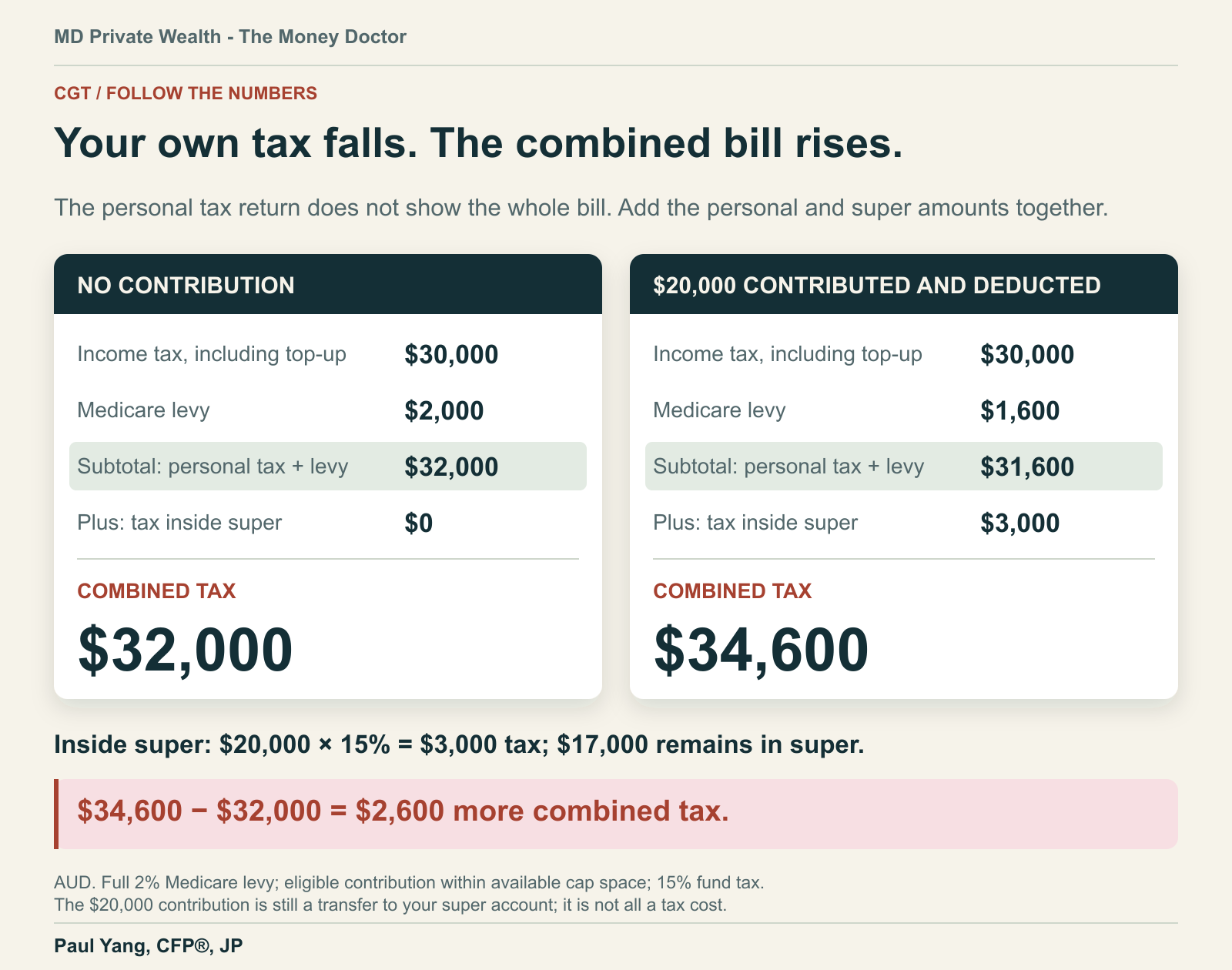
There is a saving on Medicare: 2% of $80,000 is $1,600, which is $400 less than before.
Your personal income tax and Medicare levy now total $31,600, down from $32,000. Your own tax bill has fallen by $400. The next step is to include the tax deducted inside super.
Then comes the amount easily missed when looking only at a personal tax return. Inside super, 15% of the $20,000 deductible contribution is $3,000 in contributions tax. This is deducted within the fund; it is separate from the personal tax bill.
The full calculation is therefore:
$30,000 income tax + $1,600 Medicare + $3,000 fund tax = $34,600.
Compared with $32,000 without the contribution, that is $2,600 more tax overall. The $3,000 charged inside super is greater than the $400 saved on Medicare.
The contribution itself is still an asset
The $20,000 has been transferred into super. After the $3,000 contributions tax, $17,000 remains invested, before fees or investment movements.
It would be wrong to count the entire contribution as a tax expense. The useful comparison shows three separate amounts: total tax, money held in super and cash still available outside super.
This matters if you need the sale proceeds for living costs or the personal tax bill. Money inside super is available only when the relevant release rules allow it. Also, a $100,000 capital gain does not tell us how much cash the sale produced.
Decide on the contribution after doing the comparison
A different income level can produce a different answer. If ordinary tax attributable to the gain is above the minimum, a deduction may reduce tax without the top-up replacing all the saving. The amount contributed matters too.
Ask for three versions of the calculation: no deductible contribution, a smaller amount and your intended amount. Each should include ordinary income tax, the CGT top-up, Medicare and contributions tax. Compare the cash left accessible as well as the tax totals.
Then confirm how much of your concessional contribution limit remains—the limit shared by employer contributions, salary sacrifice and personal contributions claimed as deductions. The $20,000 used here is a chosen contribution amount, not the annual cap.
Check eligibility for the deduction separately. If you are aged 67–74, claiming a deduction for a personal contribution still requires the work test or an applicable exemption, even though making a personal contribution without claiming a deduction no longer requires that test.
After contributing, submit a notice of intent telling the fund how much you intend to deduct, and obtain its acknowledgment before claiming the deduction in your tax return. Complete this process before transferring the money out or using it to start a super pension account that pays you an income.
A contribution may still support your longer-term retirement plan. Future earnings, fees, investment choices and access all matter. But the immediate tax benefit should be calculated, not inferred from the deduction.
Work out the total tax first. Then decide how much to contribute, and how much cash to keep available.
About this example: AUD; 2027–28 full-year resident adult rates; no other income, deductions, offsets or minimum-tax exception. Full 2% Medicare levy and 15% contributions tax in a taxed fund. No Medicare levy surcharge, Division 293 additional super tax, excess contributions or low income super tax offset. General information.