By Paul Yang, CFP®, JP

You bought a rental property in 2020. It has grown in value, and you see it as part of your retirement savings. When you hear that capital gains tax (CGT) is changing, your first thought is understandable: “I bought before the change. Surely the old rules still apply?”
Buying earlier does not lock in the old treatment for all future growth. In the example below, eligible growth up to 30 June 2027 keeps the 50% discount. Growth from 1 July 2027 follows the new calculation.
You still own one property. When you sell, you calculate two parts of its gain, then bring them together to work out the tax. Here is how that works.
One property, three points in time
Imagine buying a rental property for $600,000 in 2020. It is an existing home bought from another owner and has always been held as an investment.
Assume its market value at 30 June 2027 is $800,000. You keep it and sell in 2030 for $950,000.
The overall increase is $350,000. CGT is calculated on the gain from an asset, rather than on its full sale price. First, we need to find how much of this gain is included in taxable income.
This example uses the property's market value at the transition date to separate the two periods. The owner is an Australian citizen and tax resident throughout ownership, eligible for the discount and indexation rules. We assume the standard minimum-tax rules apply and leave out transaction costs, improvements and capital losses. All amounts are Australian dollars.
The first $200,000 of growth keeps its discount
The property rises from $600,000 to $800,000 before the new treatment begins:
$800,000 − $600,000 = $200,000 of earlier growth.
The eligible 50% discount means half that gain enters taxable income:
$200,000 × 50% = $100,000.
The discount reduces the gain used to calculate tax. It is not a 50% tax rate, and the resulting $100,000 is not a tax bill. It is the earlier part of the gain that will be added to your income when you sell.
The later $150,000 of growth gets an inflation adjustment
For the later period, we start from the $800,000 transition value. The rise from $600,000 to $800,000 has already been dealt with in the earlier calculation, so we do not count it again.
From that starting point to the $950,000 sale, the property gains another $150,000.
For this later part, an inflation adjustment replaces the 50% discount. It increases the starting amount used in the tax calculation to allow for rising prices. The technical term is cost-base indexation.
Suppose the permitted adjustment is 5% in total for this example:
$800,000 × 1.05 = $840,000.
The extra $40,000 is an assumed inflation allowance. The owner has not spent another $40,000. The actual adjustment would use the applicable inflation data; 5% is an example, not a forecast.
Now subtract that adjusted amount from the sale price:
$950,000 − $840,000 = $110,000 of later taxable gain.
This $110,000 enters taxable income in full. We have allowed for inflation instead of applying the 50% discount, so we do not halve the amount again.
So why does $350,000 of growth become $210,000 of taxable gain?
Put the two parts together:
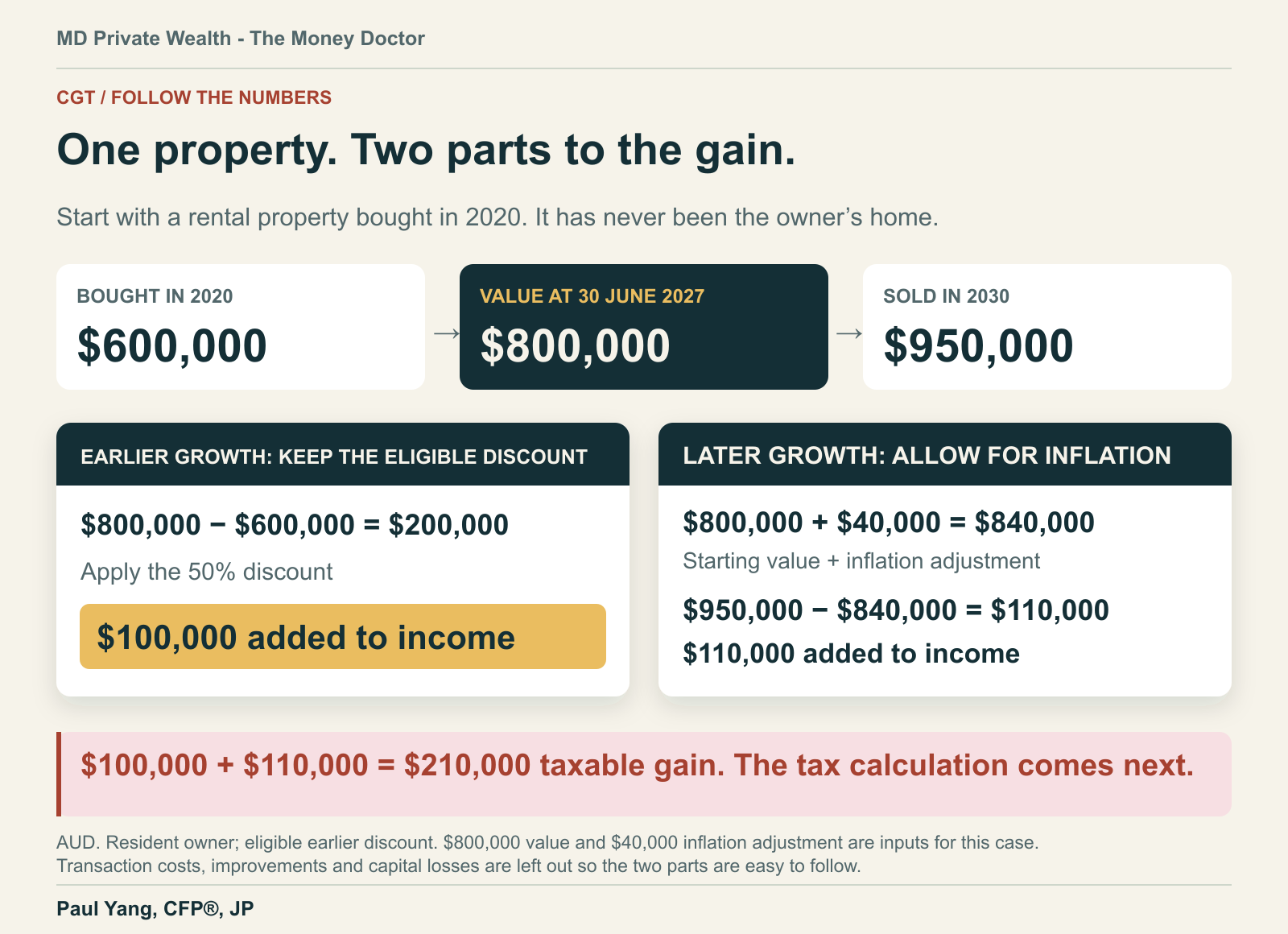
$100,000 + $110,000 = $210,000 added to taxable income. That amount joins your salary, rent and other taxable income for the sale year. The next step is to calculate tax using that year's rules.
The later $110,000 also faces the 30% minimum-tax check in this example. First, calculate how much ordinary income tax that later part adds. Compare it with $110,000 × 30% = $33,000. If the ordinary tax already reaches the minimum, there is no top-up; otherwise, a top-up fills the gap. Medicare is calculated separately.
The earlier $100,000 still attracts ordinary income tax. It simply does not form part of the gain subject to this minimum-tax check. That is why multiplying the entire $210,000 by 30% would not give you the tax bill.
Does the transition create an immediate tax bill?
For this owner, the earlier gain is deferred until the eventual sale. Holding the property through 30 June 2027 does not itself require a tax payment on the growth to that date.
The date divides the calculation. It gives you a reason to organise valuation evidence, but it does not automatically make selling before then the best decision.
Which investments need a different calculation?
This example is a personally owned rental property that has never been the owner's home. Before using it for another asset, check the owner and how the asset has been used.
- Personally held shares and fund units: the general reform can also affect their gains. The records and any fund-specific adjustments differ from a property calculation.
- Your home: the main-residence exemption can remove some or all of a gain where its conditions are met. A property used as both a home and a rental needs that history considered.
- Assets owned by a super fund: the fund calculates gains under its own CGT rules. Its tax treatment differs from that of an individual holding an asset personally.
- Trust-owned assets or qualifying new homes: separate rules can change the outcome. Confirm the applicable treatment before using the figures from this existing-rental example.
Three steps to prepare
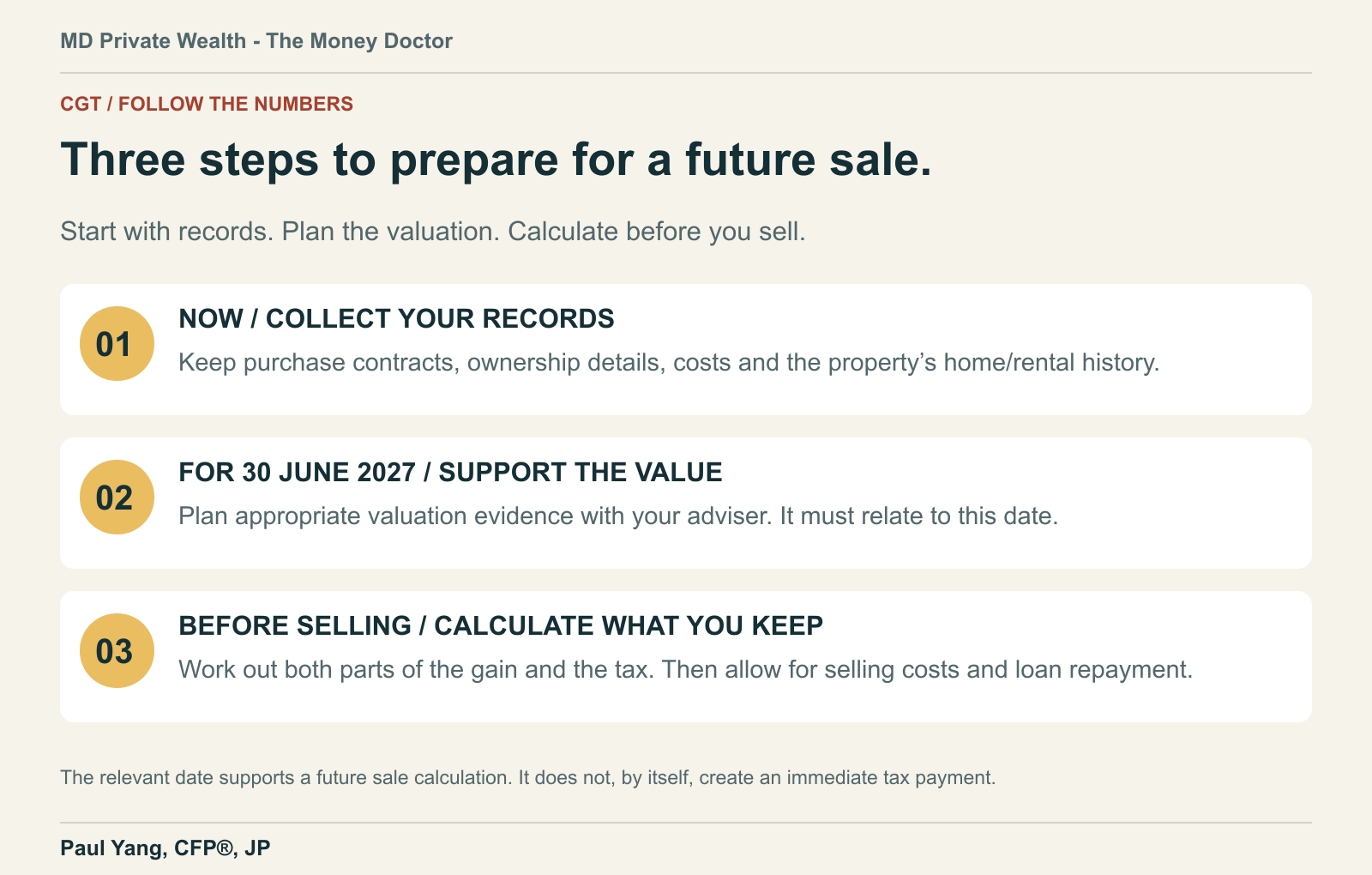
Now: collect the records. List what you own, who owns it, when it was bought and how it has been used. Keep purchase contracts, cost records and improvement invoices together.
For 30 June 2027: plan the valuation evidence. Discuss with your tax adviser how to support the property's value at that date. The evidence must relate to the transition date; the report does not have to be written on that exact day.
Before selling: calculate the money left. Work out the earlier and later gains, include the year's other taxable income, and estimate the additional tax caused by the sale. Then allow for selling costs and any loan repayment.
The useful question for your next review is: “How much of my gain belongs to each period, and what will selling leave me after tax and costs?”
An earlier purchase can preserve the treatment of earlier growth. A complete calculation shows what that means for the money available in retirement.