By Paul Yang, CFP®, JP

Your investment property could sell for $900,000. You begin thinking about what that money might make possible: leaving work, helping the children or finally taking a longer holiday.
Then the sale costs, loan repayment and tax bill enter the picture. In the example below, the amount left for retirement is $545,000.
Nothing mysterious has happened to the money. It simply had commitments to meet before it could fund your plans.
Australia's CGT reform makes it more useful to work through those commitments before choosing when to sell. Relevant gains from 1 July 2027 fall under a framework with inflation adjustments and a 30% minimum-tax calculation; earlier and later growth on an existing investment can receive different treatment.
Start with a practical question: how much will I keep, when will it arrive, and what does it need to pay for?
The loan affects your cash, not the size of your gain
Before following the sale proceeds, separate two calculations that are often confused.
The tax calculation starts with the sale and cost-base records. Your tax adviser applies the relevant CGT rules and works out the additional tax caused by selling, taking other income into account.
The cash calculation starts with the sale proceeds. You subtract the costs actually paid, repay the lender and set aside that additional tax.
Suppose two people own otherwise identical properties with the same purchase costs and tax circumstances. One has paid down more of the loan. That person keeps more cash after selling, but the smaller loan does not itself create a smaller capital gain.
The same distinction explains selling costs. An eligible cost may reduce the taxable gain, but the invoice still needs to be paid. A tax benefit does not put the entire expense back in your pocket.
Follow a $900,000 sale to the amount you can use
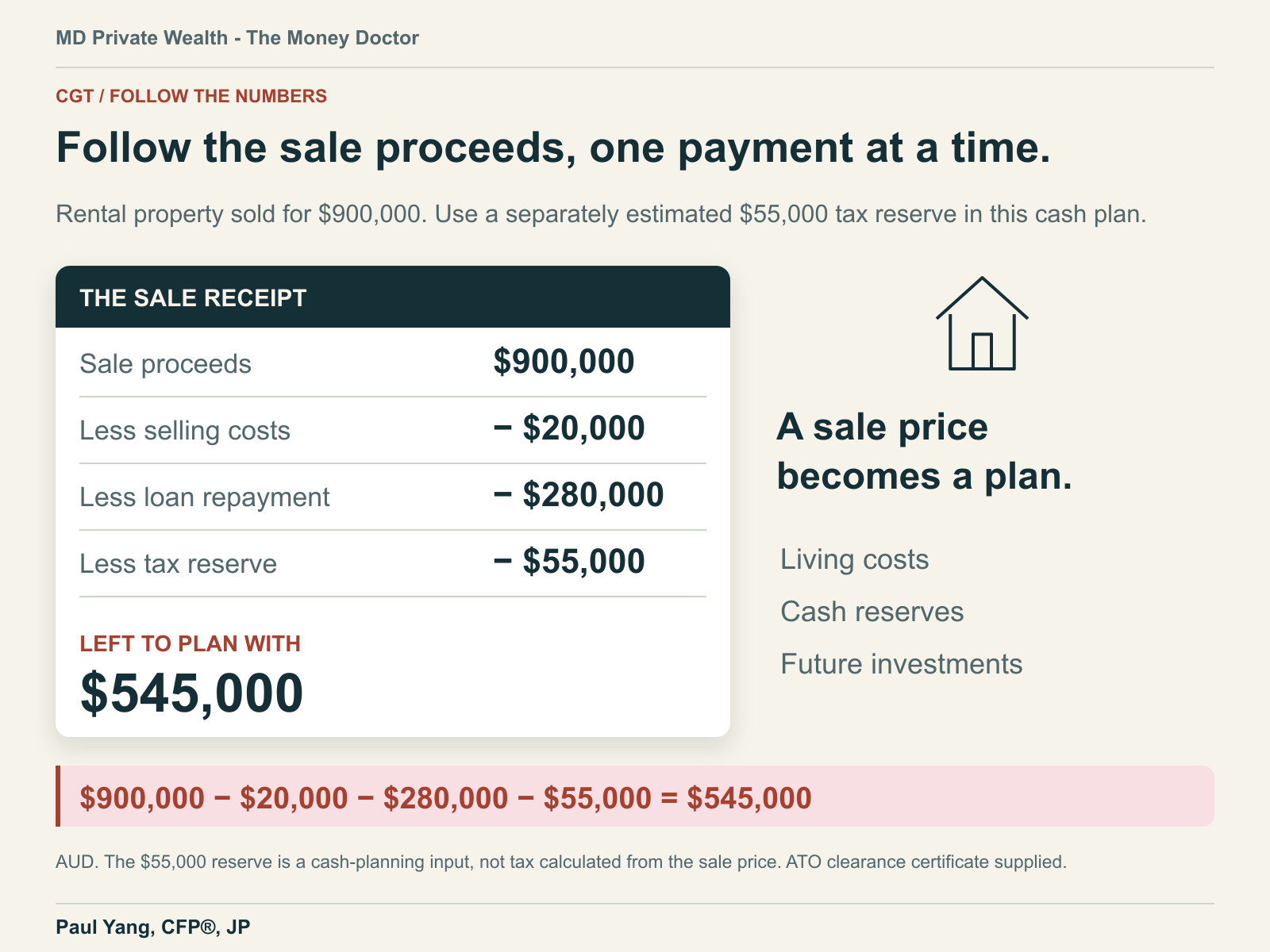
Assume the property sells for $900,000, selling costs are $20,000, and $280,000 is needed to clear the loan. The Australian resident seller provides the required ATO clearance certificate, so there is no purchaser CGT withholding at settlement.
After costs and debt, the cash is:
$900,000 − $20,000 − $280,000 = $600,000.
Now allow for tax. For this separate cash-flow example, assume the additional personal tax from selling has been estimated at $55,000, including the applicable Medicare levy. That amount is an input to our cash calculation; it has not been calculated by applying a tax rate to the sale price.
Set it aside and the amount available for retirement becomes:
$600,000 − $55,000 = $545,000.
The tax reserve may stay in your bank account until payment is due. It already has a purpose, however. Counting it as spending or investment money would give the same dollars two jobs.
Your own tax estimate should reflect the actual cost records, income and applicable CGT treatment. Update it as the likely sale terms become clearer.
Compare sale years using the same headings
You might sell while working, after your salary stops or later in retirement. To make a useful comparison, ask for each option to show the expected price, gain calculation, other taxable income and additional tax caused by the sale. Then deduct selling costs and loan repayment to find the cash remaining.
Keep the inputs consistent wherever possible. If one option assumes a higher sale price or a different super contribution, make that difference visible. Otherwise, you may mistake the effect of a changed assumption for a tax saving.
Waiting also has a cash-flow consequence. Include rent received and the loan payments, rates, insurance, maintenance and vacancy costs incurred while holding the property. A smaller future tax bill tells only part of the story.
Finally, rerun the later-sale option at a lower price, recalculating tax as well. You will see whether the remaining funds still cover the retirement plans you care about.
Check the date that determines the tax year
For an ordinary property sale under contract, the CGT event generally occurs when the contract is entered into. Settlement is when the transaction completes and the money is usually received.
A June contract with July settlement therefore does not generally move the gain into the new financial year. If the year of sale matters to your plan, confirm the position before signing.
Put the contract date, settlement date and expected tax payment timing together on the cash-flow plan. Confirm the clearance-certificate arrangements with your conveyancer too. Any purchaser withholding affects the cash received at settlement and is credited towards tax; it should not be counted again as an extra final tax cost.
Give the remaining $545,000 a purpose
Start with living costs until other retirement income begins, known larger expenses and an accessible reserve. Then consider how the balance fits alongside super and other investments.
If you plan to contribute sale proceeds to super, calculate that separately. Check eligibility, contribution type, available limits and access. For a deductible contribution, include the effect on personal tax, any CGT top-up and contributions tax inside the fund.
Ask for one final allocation showing tax reserved, cash outside super, contributions to super and other commitments. Every dollar should appear once.
A sale price tells you what the buyer pays. A retirement plan needs to show what you keep and how it will support your life.
General information. All amounts are Australian dollars.