By Paul Yang, CFP®, JP

You have an investment property and retirement is getting closer. The plan seems sensible: stop working, let your salary fall away, then sell.
Can that still save tax under Australia's CGT reform? Yes, it can. What matters is how much other taxable income you have in the financial year of the sale.
Capital gains tax, or CGT, is the tax on an investment's gain. The taxable part of that gain is added to your other income. When there is less salary using the lower tax bands, more of the gain can be taxed at lower rates.
From 1 July 2027, the reform adds a 30% minimum-tax check on the relevant later gain. That changes the calculation, but lower other income can still make a difference.
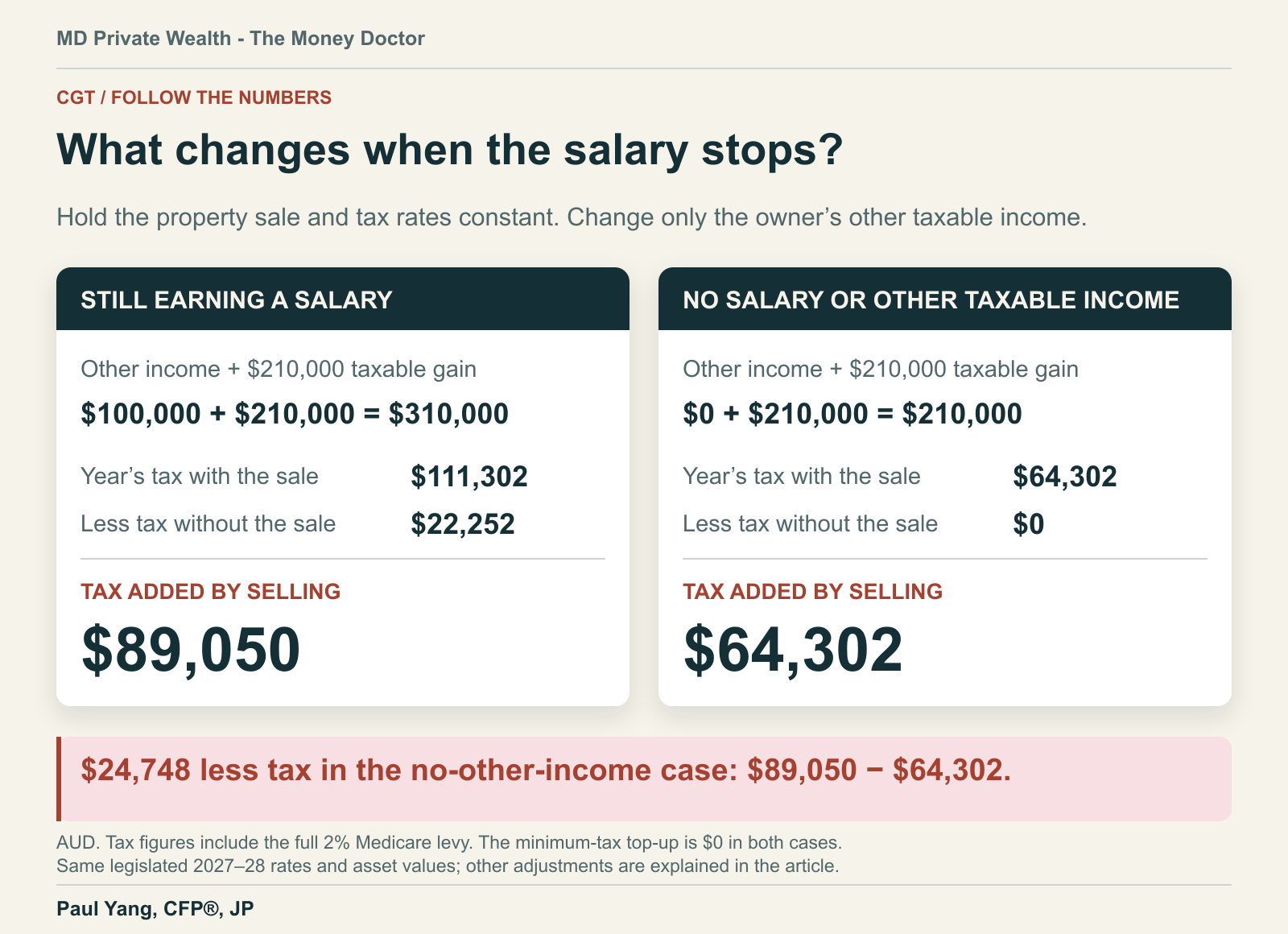
In the example below, the difference is $24,748. We compare the same sale with $100,000 of taxable salary and with no other taxable income. The property values and tax rates stay the same, so we can see the effect of income alone.
Start with one property, from purchase to sale
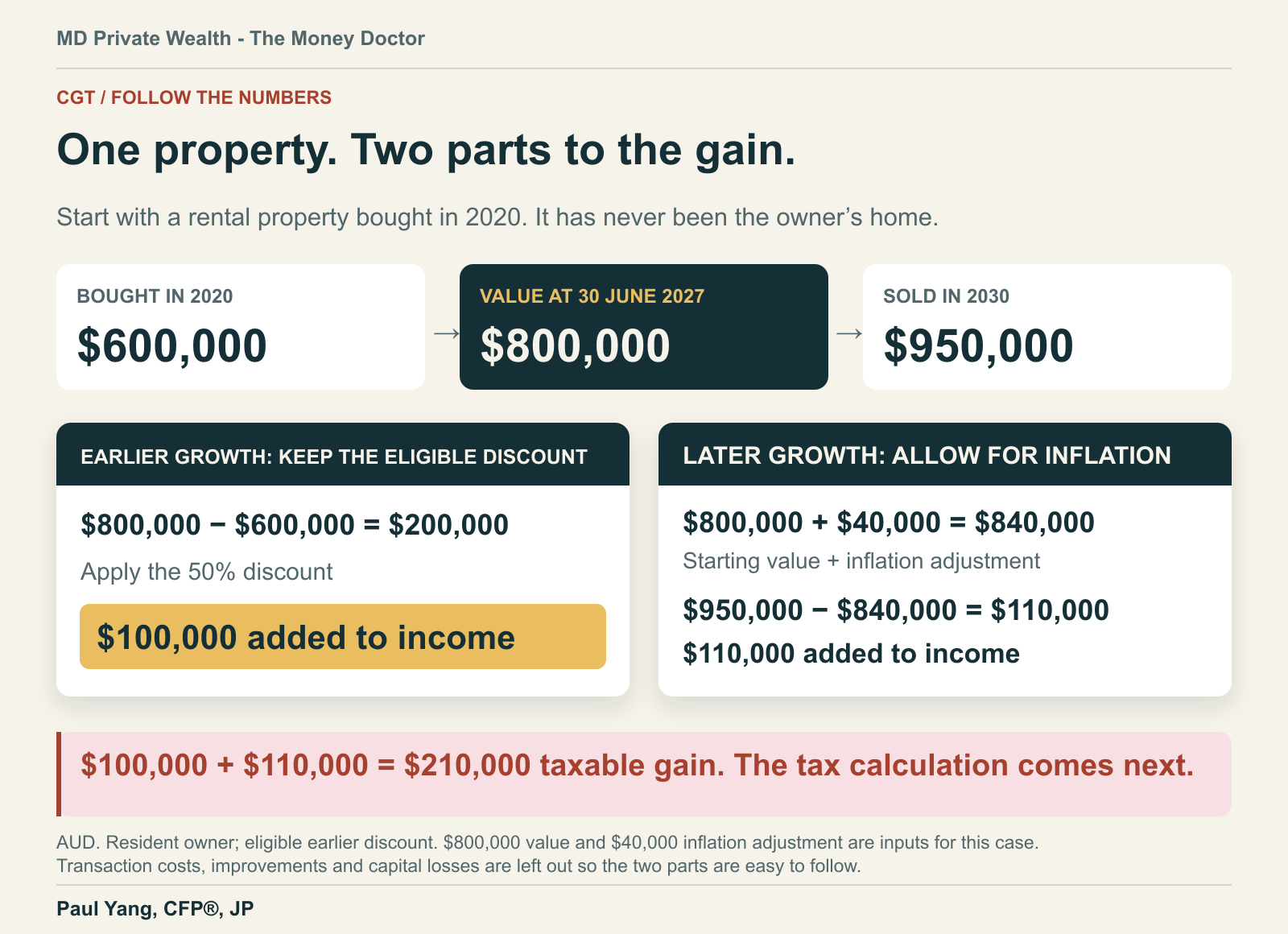
Imagine a rental property bought in 2020 for $600,000. It is worth $800,000 at 30 June 2027 and sells for $950,000 in 2030.
The owner is an Australian tax resident throughout. The property has always been an investment, and the earlier gain qualifies for the 50% discount. We leave out transaction costs, improvements and capital losses. All amounts are Australian dollars.
The $350,000 increase in value has two parts because the rules change from July 2027.
Earlier growth: $200,000, with the eligible 50% discount.
The rise from $600,000 to $800,000 is $200,000. Half—$100,000—goes into taxable income. A 50% discount means that half the gain is taxed; it does not mean a 50% tax rate.
Later growth: $150,000, before allowing for inflation.
For this part, an inflation adjustment replaces the 50% discount. Suppose the adjustment raises the $800,000 starting value to $840,000. That extra $40,000 is an assumed inflation allowance, not another payment by the owner or a forecast of future inflation.
Subtract $840,000 from the $950,000 sale price. The resulting $110,000 goes into taxable income in full; we do not halve it again.
Together, the two parts add $210,000 to taxable income: $100,000 plus $110,000. This is the amount used to calculate tax, not the tax bill.
Both parts are dealt with when the property is sold. In this case, the June 2027 transition itself does not trigger a tax payment.
What does the 30% minimum actually do?
Start with the no-other-income case. For now, we put salary, rent and other investment income aside; a real sale-year calculation would include them.
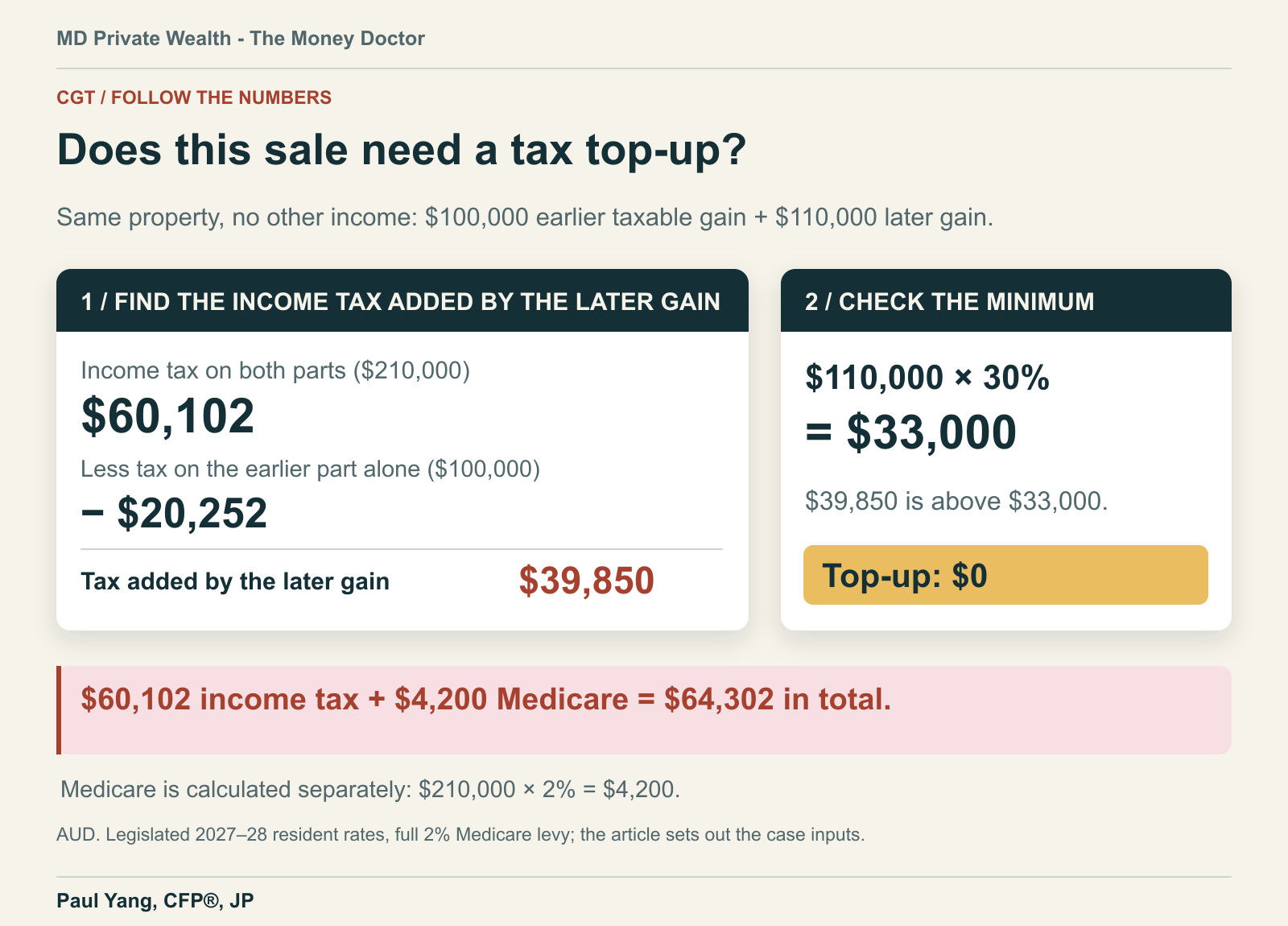
Ordinary income tax on the $210,000 taxable gain is $60,102. The minimum-tax check applies to the later $110,000, so we first work out how much ordinary tax that part has already added.
Remove the later gain for a moment. The earlier $100,000 taxable gain remains, with ordinary income tax of $20,252. This $100,000 comes from the property, even though the owner has no salary.
The ordinary tax added by the later gain is therefore:
$60,102 − $20,252 = $39,850.
Its minimum-tax amount is:
$110,000 × 30% = $33,000.
Why is the ordinary tax higher? The earlier taxable gain already occupies the lower tax bands. The later $110,000 sits above it, with portions taxed at 30%, 37% and 45%.
Because $39,850 already exceeds $33,000, no top-up is needed. The 30% minimum fills a shortfall; it is not another 30% added to the ordinary tax bill.
Medicare is separate. Add the standard 2% levy of $4,200 to the $60,102 income tax: $64,302 in total.
So does waiting until retirement still help?
Now compare that result with the same sale in a year when the owner has $100,000 of taxable salary. This salary is additional to the property's $210,000 taxable gain.
Taxable income becomes $310,000. Income tax and Medicare total $111,302, with no minimum-tax top-up needed in this case either.
But $111,302 is the whole year's tax. The owner would already owe $22,252 on the salary without selling. To find the cost caused by the sale, subtract that amount:
$111,302 − $22,252 = $89,050 of additional tax.
With no other income, the sale adds $64,302. The difference is $89,050 − $64,302 = $24,748.
So lower income still helps in this example. The new minimum does not make the two tax bills equal. The $24,748 is the difference between these two income situations, rather than a prediction of what waiting will save on a particular property.
Both calculations use the legislated 2027–28 and later resident rates and the full 2% Medicare levy. Tax offsets, levy reductions and the Medicare levy surcharge are excluded.
Check the super contribution separately
If you plan to contribute sale proceeds to super and claim a deduction, calculate that step separately.
An eligible deduction reduces taxable income. In some situations, that lowers the ordinary tax on the later gain below the minimum, so a larger top-up can offset some of the saving. This does not happen with every contribution.
Also include any contributions tax deducted inside super when comparing the overall cost. It is a separate cost; it does not count as tax paid towards the personal 30% minimum.
Compare no deductible contribution, a smaller amount and your intended amount. Check your available contribution limits and the cash you need outside super before deciding how much to contribute.
Turn the calculation into a retirement decision
First, identify the right financial year. Retiring in December and signing a sale contract the following March puts both events in the same Australian financial year. Salary earned before retirement still counts. For a normal property sale, the contract date generally determines the CGT year, even if settlement happens later.
Next, prepare the figures. Keep purchase and improvement records, and ask your adviser what valuation evidence to retain for 30 June 2027. Estimate the whole year's taxable income, including salary, rent, interest and other investment income.
Then compare what you would keep. For each sale option, deduct the additional tax, selling costs and loan repayment. If one option involves waiting, also allow for the extra rent, interest, repairs and a possible change in sale price.
Retiring before selling can still reduce tax. The useful decision is which timing leaves you with enough accessible money to fund retirement.
Work out what you will keep. Then choose when to sell.